

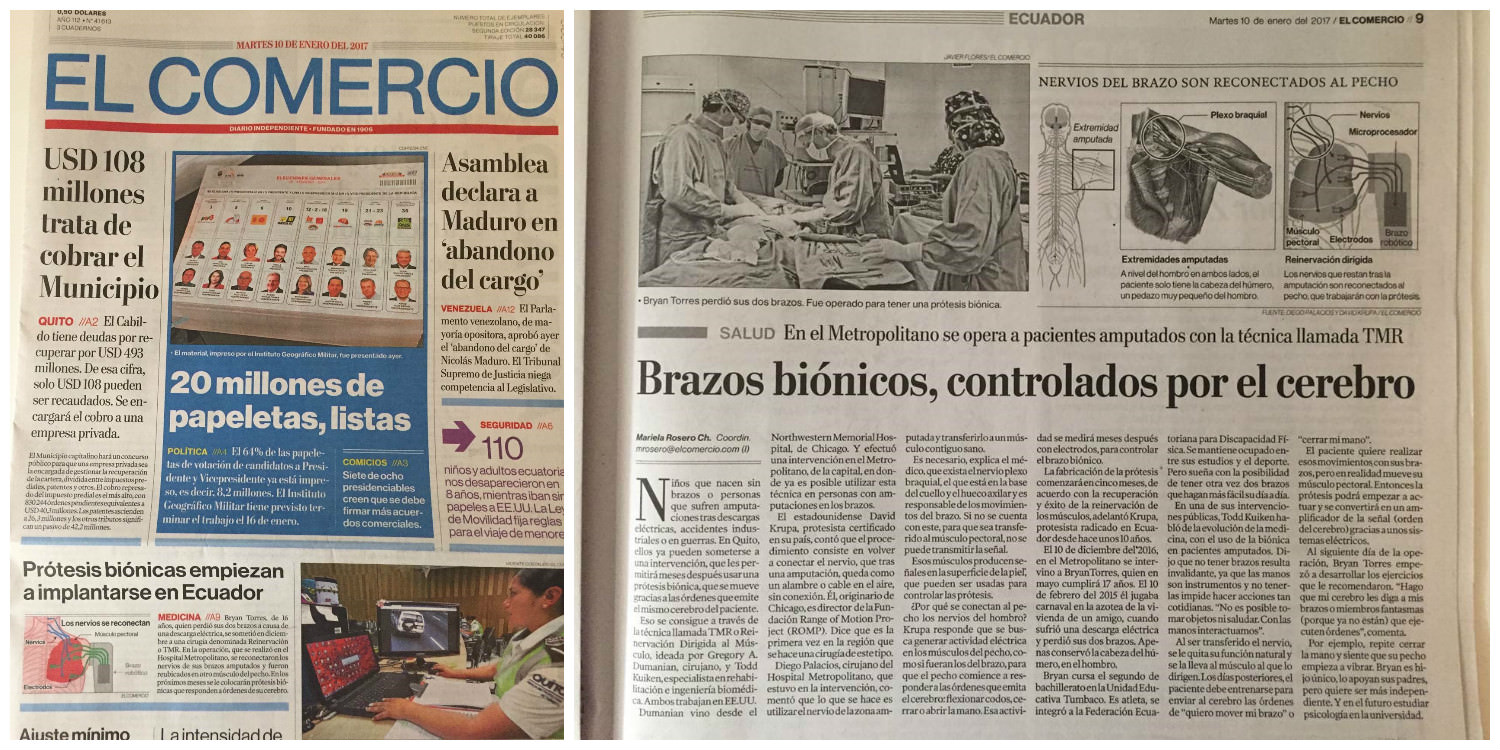
Dr. Dumanian and physiatrist Dr. Todd Kuiken created a revolutionary new technique for the treatment of upper extremity amputee patients for the control of their prostheses. Known as Targeted Muscle Reinnervation (TMR), this revolutionary procedure allows amputees to move their prosthetic arm by simply thinking what movements they wish to accomplish. First performed by Dr. Dumanian in 2002 at Northwestern Memorial Hospital, it was the first improvement in upper extremity prosthetics since the 1950’s. A team approach to the care of the amputee involves evaluations by prosthetists, occupational therapists, and plastic surgery. All procedures are performed by Dr. Dumanian and his colleagues. His work is documented in major medical publications including the Lancet, the Annals of Surgery, Plastic and Reconstructive Surgery, and the Journal of Bone and Joint Surgery. A side benefit of the surgery is typically a decrease in the amount of pain and phantoms that the amputee feels in his or her residual limb.
TMR taps into the peripheral nervous system for the information needed to control a myoelectric prosthesis. The nerve signals that used to control the arm are transferred to local otherwise functionless muscles. The larger muscles then amplify the signal, so that the electric impulses can be picked up through the skin by sensors. There is nothing implanted, no wires, and no batteries. Prosthetic function after TMR is smooth, fast, and can occur with much less training.
Patients interested in this procedure should contact Dr. Dumanian through the number below, and you will need to make a trip to Chicago for an office visit. Remember to bring any photographic images of the time of the amputation, operative reports, and x-rays on a disk with you for your visit.
Northwestern wins grant to help amputees with chronic pain
CV & Publications
Bionic Arm Videos/Articles
- Bionic Arm in patient with transhumeral amputation: an amputation above the elbow.
- Bionic Arm in patient with shoulder disarticulation: an amputation at the shoulder.
- Article: Bionic Arms, Controlled by the Brain – (Photos)
Additional Resources
- The Rehabilitation Institute of Chicago has articles from medical journals describing the procedure, and videos of some of our patients.
- Wikipedia entry on targeted muscle reinnervation
- New York Times article on targeted muscle reinnervation
Targeted Muscle Reinnervation Articles by Dr. Dumanian
- Targeted Muscle Reinnervation in Oncologic Amputees
- Targeted muscle reinnervation and prosthetic rehabilitation
after limb loss - Lancet Targeted Innervation
- New Yorker
- Targeted Muscle Reinnervation for Transhumeral Amputees
- Targeted muscle reinnervation in the initial management of traumatic upper extremity amputation injury
- Targeted muscle reinnervation and upper limb amputation
- Targeted Muscle Reinnervation and Advanced Prosthetic Arms
- Targeted Muscle Reinnervation: A Novel Approach to Postamputation Neuroma Pain
- Risks and Benefits of Transplantation
- Targeted Muscle Reinnervation in the Lower Leg
Nerve
Hernia
General Reconstruction
More about Dr. Dumanian
Dr. Dumanian is a surgical innovator and the first to perform targeted muscle reinnervation. He also is the developer of Mesh Suture. The open mesh design distributes forces to prevent the suture from tearing through tissues in abdominal wall surgery and orthopedics. Dr. Dumanian is also recognized for his work in rectus diastasis / abdominal hernia surgery. To learn more, or to schedule a consultation, contact Dr. Dumanian at 312-695-6022.